Hoy recorremos este Ático Dúplex de Lujo a estrenar en Palo Alto, Ojén-Marbella Más información sobre este moderno Ático Dúplex: Precio: 2.400.000 € | Dormitorios: 3 | Baños: 2 | Construidos: 154 m² | Terraza: 306 m²
Este fascinante ático dúplex moderno en venta se encuentra en el exclusivo complejo residencial cerrado Palo Alto, en Ojén, una zona de auténtica belleza natural con vistas panorámicas de los alrededores, majestuosas montañas y el mar Mediterráneo hasta África. Situado en la tranquila campiña andaluza, está a sólo unos minutos en coche de la cosmopolita Marbella (6,7 km) y de todos los servicios. La nueva residencia ecológica se ha inspirado en el estilo arquitectónico contemporáneo y vanguardista, ofreciendo formas geométricamente bellas y líneas sencillas de arquitectura inflexible y funcional con zonas de estar abiertas. Su sofisticada paleta de colores utiliza sencillos tonos blancos, neutros y de madera, y mantiene un equilibrio perfecto entre el hombre y la naturaleza.
Rodeado de otras propiedades de gama alta y de hermosa naturaleza, el ático de 2 niveles orientado al sur de 154 m² con terrazas de 306 m² dispone de 3 serenos dormitorios, 2 modernos cuartos de baño y un aseo de invitados, un amplio y elegante salón de planta abierta con sala de TV, zona de comedor y cocina blanca elegante de estilo minimalista totalmente equipada con una isla/zona de desayuno. Las ventanas de suelo a techo y las puertas correderas de cristal dejan entrar el sol y la luz del día y conectan los interiores con las zonas exteriores que invitan a disfrutar del chill out, las cenas al aire libre y las zonas de barbacoa. El ático también cuenta con un increíble solárium con piscina en la azotea, rincones románticos e impresionantes vistas al mar. El apartamento de lujo se vende en excelentes condiciones, con acabados y comodidades de la mejor calidad. Está amueblado con gusto en estilo moderno y ofrece muchas prestaciones que harán que tu vida sea súper cómoda y agradable. La fabulosa propiedad dispone de ascensor, sistema de domótica, aire acondicionado, sistema Dolby Stereo Surround, doble acristalamiento, suelos de parqué y piedra con calefacción por suelo radiante, persianas eléctricas, armarios empotrados, iluminación LED, trasteros y lavaderos, etc.).
Con todas estas comodidades y 3 plazas de aparcamiento en el garaje incluidas, podrás disfrutar de la comodidad de la vida urbana sin renunciar al lujo y al placer de vivir en el regazo de la naturaleza. Enclavada en la espectacular campiña de los Montes de Ojén, la lujosa comunidad en la cima de la colina Palo Alto, con una arquitectura de vanguardia, está diseñada por la famosa y galardonada firma Villarroel – Torrico. Las montañas del Parque Natural de la Sierra de las Nieves sirven de impactante telón de fondo. La Fase 1 de la urbanización ofrece 2 piscinas exteriores privadas de agua salada, jardines paisajísticos y zonas de juego. Tendrás acceso a magníficos servicios, como un Club de Salud con SPA, piscina cubierta climatizada, sauna, baño turco y gimnasio; Club Social; Valle de la Serenidad; Centro Ecuestre; pista de tenis/pádel; Club Infantil; y, por supuesto, servicios de gestión de la propiedad. Podrás disfrutar de una vida de lujo, ya sea relajándote en una piscina infinita, montando a caballo por las colinas o tomando cócteles en una terraza privada. ¡Todo lo que necesitas para el mundialmente famoso estilo de vida mediterráneo! Un portero, entrada controlada a la comunidad, servicio de seguridad 24 h, cámaras de vigilancia, sistema de alarma y entrada de vídeo a la propiedad te darán tranquilidad.
https://www.myluxepoint.com/wp-content/uploads/2023/06/Visita-un-atico-duplex-de-lujo-de-E2.400.000-con-vistas-y-comodidades-en-Palo-Alto-Ojen-1.jpeg620930Carloshttps://www.myluxepoint.com/wp-content/uploads/2017/11/logo2v-1.pngCarlos2023-06-09 20:49:572023-06-10 12:38:04Visita un ático dúplex de lujo de €2.400.000 con vistas y comodidades en Palo Alto, Ojén | Drumelia
LeMans 9 jun 2023 #Rolex #LeMans24 #Perpetual The 24 Hour sof LeMans, the world’s oldest, most prestigious endurance race, this year celebrates its centenary. Since 1923, some of the greatest names in motor sport have been drawn to the the Circuit de la Sarthe in France for this twice-around-the clock epic that tests drivers’ physical and mental stamina along with the reliability of their machines. This mythical contest represents a century of technological advancements, extraordinary human endeavour and heroic performances. Rolex has been the race’s Official Timepiece for more than 20 years, and since 2007, the winning drivers have received a specially engraved Oyster Perpetual Cosmograph Daytona.
Discover more Rolex’s close ties with motor sport date back to Sir Malcolm Campbell’s World Land Speed Record successes in the 1930s, when he became the first driver to break the 300 mph barrier (483 km/h) at the wheel of his car, Bluebird. Since then, Rolex’s presence in motor racing has grown steadily, its support extending to revered endurance events such as the Rolex 24 At DAYTONA, the 24 Hours of Le Mans and the FIA World Endurance Championship. In 2013, Rolex became associated with Formula 1®, the pinnacle of motor sport, having supported Rolex Testimonee Sir Jackie Stewart since 1968. The three-time FIA Formula 1® Drivers’ World Champion has been joined by fellow high achievers from the world of motor sport: Tom Kristensen, the record nine-time 24 Hours of Le Mans winner, and Mark Webber, the multiple Formula 1® race winner and 2015 FIA World Endurance Champion. The brand also has a global appreciation for classic automotive events steeped in elegance, beauty and tradition, including the Pebble Beach Concours d’Elegance®, The Quail, A Motorsports Gathering, the Rolex Monterey Motorsports Reunion and the Goodwood Revival. #Rolex#LeMans24#Perpetual
https://www.myluxepoint.com/wp-content/uploads/2023/06/Rolex-celebrates-100-years-of-the-24-hours-of-Le-Mans.jpg6641048Carloshttps://www.myluxepoint.com/wp-content/uploads/2017/11/logo2v-1.pngCarlos2023-06-09 20:42:262023-06-09 20:42:38Rolex celebrates 100 years of the 24 hours of Le Mans
To create the fastest road-legal car on the Nürburgring Nordschleife
Power-to-weight ratio of roughly one hp per 2.2 lbs. (1 PS per kilogram)
Significantly more downforce than the current 911 GT3 RS
Charges roughly twice as quickly as the Taycan Turbo S
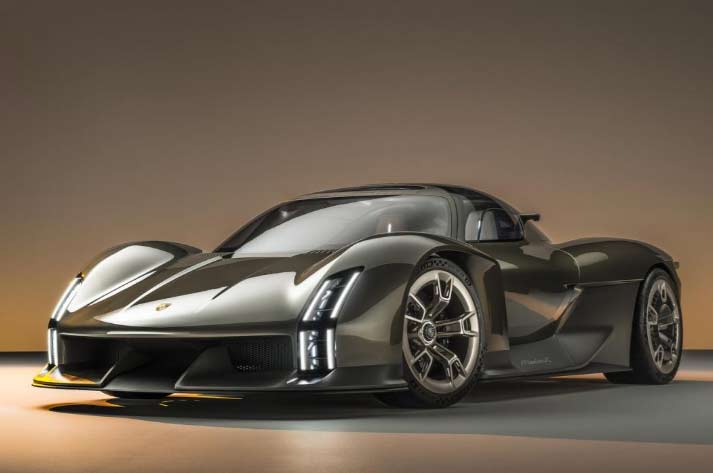
At Porsche, innovative concept cars have always laid the groundwork for the future. The sports car manufacturer is continuing this tradition with this latest concept study. Mission X is a spectacular, conceptual reinterpretation of a hypercar, with Le Mans-style doors that open upwards to the front and an ultra high-performance, efficient electric powertrain.Atlanta. Celebrating 75 years of Porsche sports cars, the storied marque today revealed its newest concept car: the Mission X. As a design study, not offered for sale, with production to be decided in due time, the Mission X is a glimpse into what the sports car of the future could look like.
“The Porsche Mission X is a technology beacon for the sports car of the future. It picks up the torch of iconic sports cars of decades past: like the 959, the Carrera GT and the 918 Spyder before it, the Mission X provides critical impetus for the evolutionary development of future vehicle concepts,” says Oliver Blume, Chairman of the Executive Board of Porsche AG. “Daring to dream and dream cars are two sides of the same coin for us: Porsche has only remained Porsche by constantly changing.”
Michael Mauer, Head of Style Porsche, says:“The Mission X is a clear commitment to the core of the brand. The continuing, enhanced expression of our brand and product identity is an important compass for us to navigate the development of our series-production models. The concept study symbolizes a symbiosis of unmistakable motorsport DNA with a luxurious overall impression.”
Measuring approximately 177 inches long and 78.7 inches wide, the Mission X concept study is a relatively compact hypercar. With a wheelbase of 107.4 inches, it has the dimensions of the Carrera GT and 918 Spyder. For aerodynamic purposes, the concept car has staggered tires, with 20-inch wheels at the front and 21-inch wheels at the rear.
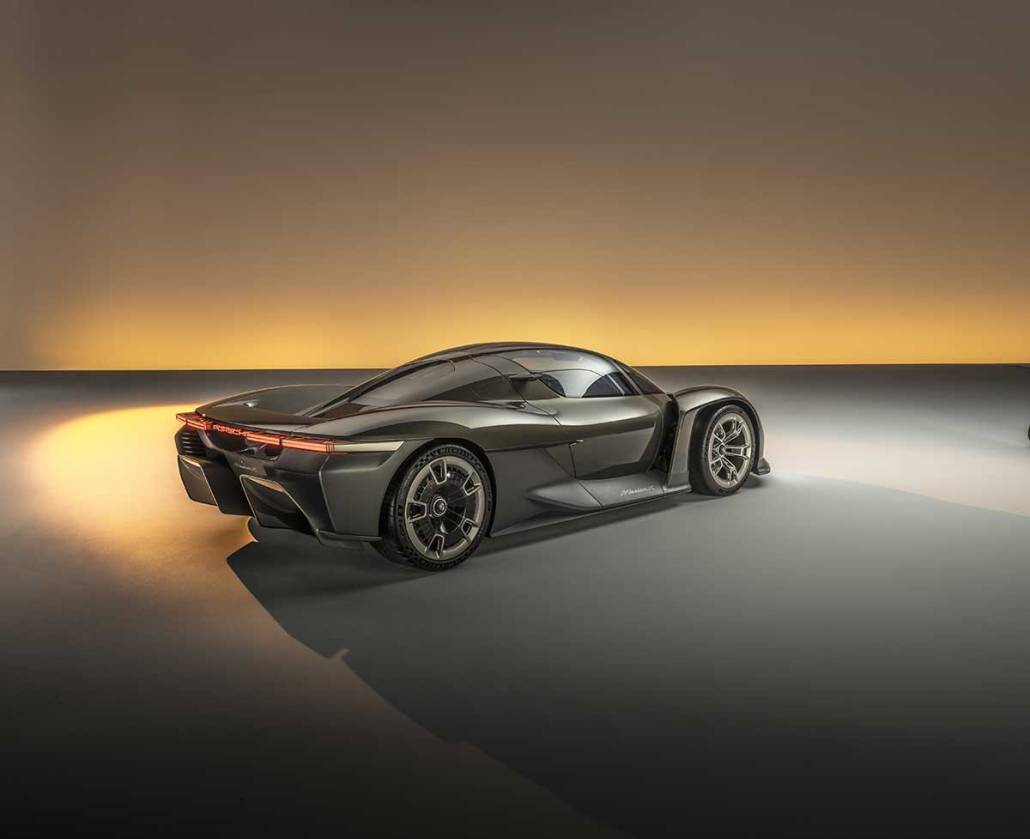
Design: classic brand elements reinterpreted The Mission X represents the pinnacle of performance and modern luxury. At the same time, its sculpted form and muscular lines demonstrate that hypercars do not have to look aggressive. The low-slung body, which is less than 47.2 inches tall, is finished in Rocket Metallic – an elegant paint color specially designed for the concept study. Design elements in a carbon fiber are found below the beltline. These components have a satin finish and are therefore slightly colored, but their material structure remains recognizable.
The wheels of the concept study feature elaborate details: the rear axle is fitted with almost transparent aero blades, which are designed like turbines for better cooling of the brakes.
A lightweight glass dome with an exoskeleton made of carbon fiber reinforced plastic (CFRP) extends over both occupants. Le Mans-style doors are attached to the A-pillar and the roof; they open forwards and upwards. This type of door was previously used on the legendary Porsche 917 racing car. Another eye-catcher is the light signature: for the Mission X, the designers have reinterpreted the characteristic Porsche four-point graphic. The vertical base form of the headlights was inspired by historic racing cars such as the Porsche 906 and 908 and drawn well down towards the road. A high-tech support structure frames the LED light modules and presents the exposed narrow elements of daytime running lights and indicators. When activated, the light opens up like an eye blinking open. Fully illuminated, the headlights make a confident statement.
A full-length light unit that appears to float characterizes the rear of the Mission X. Transparent, illuminated Porsche lettering is a standout feature. The sculptural rear light emerges, as if suspended in the air, from a support structure and extends across the entire width of the vehicle in four segments. While charging, the ‘E’ of the Porsche lettering pulses.
One special detail is the modernized Porsche crest, which makes its debut on the Mission X. Brushed precious metal, a three-dimensional honeycomb structure, a refreshed heraldic beast and more subtle gold color – on close inspection, these are the differences between the modernized Porsche crest and its immediate forerunner. With its cleaner and more state-of-the-art execution, the refined crest communicates the character of Porsche. On the Mission X, it is found on the hood and steering wheel as well as in monochrome form on the wheel centers.
The driver focus can be seen in the asymmetry of the interior and its color concept. The two seats are colored differently. Apart from the leather pads in Andalusia Brown, the driver’s seat is Kalahari Grey and forms a single unit of color with the center console and the dashboard. The passenger seat is in the contrasting Andalusia Brown shade. Beyond the CFRP seat shells, and their six-point seatbelts integrated into the monocoque, further motorsport parallels include the open-top steering wheel, which has mode switches and shift paddles. There are multiple cameras on board. Recording starts as soon as the driver presses the Record button (REC) on the multi-purpose controller.
Another highlight is found on the passenger side, where there is a bayonet system embedded in the instrument panel to which a stopwatch module can be attached. For the Mission X, Porsche Design has created a special stopwatch module with an analogue and digital display. The clocks are designed for both racetrack and rally use and can display the lap times or vital data of the driver, among other information.
Technical vision: top marks in power-to-weight ratio, downforce and charging performance Porsche exemplifies e-performance yet is also a pioneer in sustainable mobility. The concept study meets both objectives in full measure. If the Mission X goes into series production, then it should: • be the fastest road-legal vehicle around the Nürburgring Nordschleife • have a power-to-weight ratio of roughly one hp per 2.2 lbs. • achieve downforce values that are well in excess of those delivered by the current 911 GT3 RS • offer significantly improved charging performance with its 900-volt system architecture and charge roughly twice as quickly as the current Porsche frontrunner, the Taycan Turbo S
The battery is installed centrally behind the vehicle’s seats. This ‘e-core layout’ centers the mass in the car. As with a conventionally powered mid-engine car, this provides the basis for excellent agility.
Predecessors: innovative super sports cars from Porsche The fastest series-production car of its time; first series-production Porsche to be made of carbon fiber, and the first road-legal vehicle to beat the seven-minute mark on the Nürburgring Nordschleife – the Porsche 959 (1985), Carrera GT (2003) and 918 Spyder (2013) were milestone models in the world of super sports cars. And that makes them the conceptual forerunners of the Mission X.
In 1985, the Porsche 959 made its debut as a technology platform. Its 443 hp six-cylinder twin-turbo boxer engine, combined with an aerodynamically optimized body, propelled the super sports car to a top speed of 197 mph – then the world record for a series-production sports car. With its V10 engine and 605 hp, fierce design and, not least, its incomparable driving experience, the Porsche Carrera GT remains an icon among super sports cars to this day.
Porsche hybrid technology reached a spectacular zenith with the 918 Spyder. In September 2013, the 887 hp two-seater was the first road-approved vehicle to crack the seven-minute barrier on the 12.8-mile Nürburgring Nordschleife, completing the lap in 6:57 minutes. Porsche aims to stay true to this standard of the highest e-performance: our vision, should the Mission X go into series production, is for it to be the fastest road-legal vehicle on the Nürburgring Nordschleife. On our press microsite for the Porsche Mission X you will find both the detailed press kit and a generous selection of additional photos and video
About Porsche Cars North America, Inc. | One Porsche Drive, Atlanta, GA 30354 USA Established in 1984, Porsche Cars North America, Inc. (PCNA) is the exclusive U.S. importer of the Porsche 911, 718 Boxster, 718 Cayman, Macan, Cayenne, Panamera and Taycan. Headquartered in Atlanta, Georgia, since 1998, PCNA is home to the first Porsche Experience Center in North America, which features two module-based 1.6 mile driver development tracks, a business center and Restaurant 356. The campus is also home to the U.S. headquarters of Porsche Classic. The company operates a second Porsche Experience Center near Los Angeles. That complex features a driver development track with eight educational modules totaling 4.1 miles, a business center, Restaurant 917 and the headquarters of Porsche Motorsport North America. PCNA supports 197 independently owned and operated Porsche Centers in the U.S., including supplying parts, service, marketing, and training. They, in turn, work to provide Porsche customers with a best-in-class experience that is in keeping with the Porsche brand’s 75-year history of leadership in the advancement of vehicle performance, safety, and efficiency. PCNA is an indirect wholly-owned subsidiary of Porsche AG, which is headquartered in Stuttgart, Germany.