Porsche put in a robust performance in fiscal year 2022, with a slight increase in deliveries. The sports car manufacturer delivered a total of 309,884 cars over the past 12 months, 3 per cent more than in 2021 – despite several global crises.
Porsche fulfills the dreams of its customers, as strong delivery figures and the continued good order situation for fiscal year 2022 demonstrate. Worldwide, the sports car manufacturer delivered 309,884 vehicles to customers last year, an increase of 3 per cent over the previous year.
Detlev von Platen, Executive Board Member for Sales and Marketing at Porsche AG
“The many challenges caused by the war in Ukraine, interrupted supply chains and the ongoing semiconductor crisis have shaped the past year and put us to the test,” says Detlev von Platen, Executive Board Member for Sales and Marketing at Porsche AG. “So I am all the prouder of the entire Porsche team. In this difficult environment, we have succeeded in fulfilling the dream of owning a Porsche for more customers than ever before.”
Deliveries in Europe 7 per cent above previous year
In the Europe sales region, Porsche delivered 62,685 cars in 2022. This is 7 per cent more than in the previous year. In its home market of Germany, 29,512 customers took delivery of their cars – an increase of 3 per cent. In North America, Porsche recorded 79,260 deliveries, matching the previous year’s level. This was a particularly strong performance in view of logistical and supply challenges that started the year. In what remains the biggest single market, China, 93,286 cars were delivered to customers (-2 per cent). The slight dip here is mainly due to the effects of the COVID pandemic. Waves of infection, COVID-related lockdowns and logistical challenges affected the deliveries. The Overseas and Emerging Markets sales region continues to develop positively with an increase in deliveries of 13 per cent. Some 45,141 cars were delivered to customers in this region during 2022.
SUVs remain popular among customers
The models with the highest demand again in 2022 were the brand’s SUVs: the Porsche Cayenne was delivered a total of 95,604 times. The Macan followed in second place with 86,724 units delivered. With 40,410 deliveries (+5 per cent) the Porsche 911 remains very popular as well. The sports saloon Panamera was delivered to 34,142 customers (+13 per cent).
The Taycan remains at a high level of orders. In 2022, Porsche delivered 34,801 cars from the model line worldwide (-16 percent). The decline was due to supply chain bottlenecks and limited component availability. Both issues affected the electric sports car in particular. Customers took delivery of 18,203 units of the 718 Boxster and 718 Cayman models.
Taycan GTS and Taycan GTS Sport Turismo
“On the sales side, results have been positive in 2022,” says von Platen. “Porsche is in a solid position. And we’re building on that basis.”
Porsche AG
Deliveries
January – December
2021
2022
Difference
Worldwide
301,915
309,884
+3%
Germany
28,565
29,512
+3%
North America
79,166
79,260
0%
China
95,671
93,286
-2%
Europe (excluding Germany)
58,576
62,685
+7%
Overseas and Emerging Markets
39,937
45,141
+13%
Disclaimer
This announcement contains ‘forward-looking statements’ that reflect the Porsche’s current view of the future events.
Words such as ‘will’, ‘presume’, ‘as a goal’, ‘could’, ‘possibly’, ‘should’, ‘believe’, ‘intend’, ‘plan’, ‘in preparation’, and ‘aim’ are used to indicate statements relating to the future. These statements are subject to a variety of risks, uncertainties and assumptions. If any of these risks or uncertainties materialise or if the assumptions underlying Porsche’s forward-looking statements should prove unfounded, the actual results could differ significantly from the ones that Porsche has expressly or implicitly assumed in these statements. Forward-looking statements in this press release are based solely on the circumstances pertaining on the day of publication.
These forward-looking statements will not be updated later. These statements are true on the day of publication and may be overtaken by later events.
More and more vehicle functions are based on artificial intelligence. However, conventional processors and even graphics chips are increasingly reaching their limits when it comes to calculations required for neural networks. Porsche Engineering reports on new technologies that will speed up AI calculations in the future.
Artificial intelligence (AI) is a key technology for the automotive industry—and fast hardware is correspondingly important for the complex back-end calculations involved. After all, it will only be possible to bring new functions into series production in the future with high-performance computers. “Autonomous driving is one of the most demanding AI applications of all,” explains Dr. Joachim Schaper, Senior Manager AI and Big Data at Porsche Engineering. “The algorithms learn from a multitude of examples collected by test vehicles using cameras, radar, or other sensors in real traffic.”
Dr. Joachim Schaper, Senior Manager AI and Big Data at Porsche Engineerin
Conventional data centers are increasingly unable to cope with the growing demands. “It now takes days to train a single variant of a neural network,” explains Schaper. So in his view, one thing is clear: Car manufacturers need new technologies for AI calculations that can help the algorithms learn much faster. To achieve this, as many vector-matrix multiplications as possible must be executed in parallel in the complex deep neural networks (DNNs)—a task in which graphics processing units (GPUs) specialize. Without them, the amazing advances in AI in recent years would not have been possible.
50 times the size of a GPU
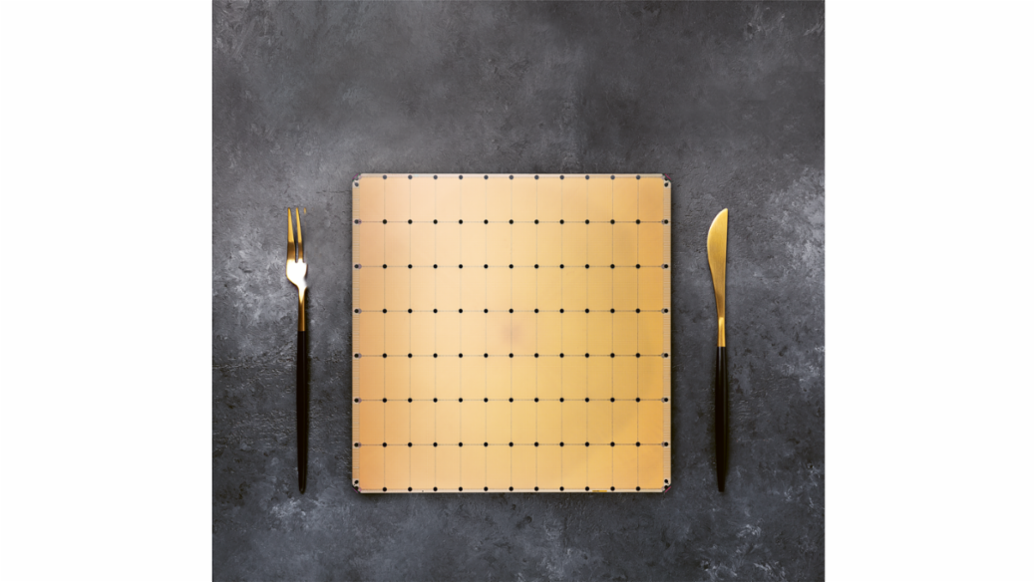
Graphics cards were not originally designed for AI use, however, but to process image data as efficiently as possible. They are increasingly stretched to the limit when it comes to training algorithms for autonomous driving. Hardware specialized in AI is therefore required for even faster calculations. The Californian company Cerebras has presented a possible solution. Their Wafer Scale Engine (WSE) is optimally tailored to the requirements of neural networks by combining as much computing power as possible on one giant computer chip. It is more than 50 times the size of a normal graphics processor and offers space for 850,000 computing cores—over 100 times as many as on a current top GPU.
In addition, Cerebras engineers have networked the computational cores together with high-bandwidth data lines. According to the manufacturer, the network on the Wafer Scale Engine transports 220 petabits per second. Cerebras has also widened the bottleneck within the GPUs: Data travels between memory and computing unit nearly 10,000 times faster than in high-performance GPUs—at 20 petabytes per second.
Giant chip: Cerebras’ Wafer Scale Engine combines enormous computing power on a single integrated circuit with a side length of more than 20 centimeters.
To save even more time, Cerebras mimics a trick of the brain. There, neurons work only when they get signals from other neurons. The many connections that are currently inactive do not need any resources. In DNNs, on the other hand, vector-matrix multiplication often involves multiplying by the number zero. This costs time unnecessarily. The Wafer Scale Engine therefore refrains from doing so. “All zeros are filtered out,” Cerebras writes in its white paper on the WSE. So the chip only performs operations that produce a non-zero result.
One drawback of the chip is its high electrical power requirement of 23 kW and requires water cooling. Cerebras has therefore developed its own server housing for use in data centers. The Wafer Scale Engine is already being tested in the data centers of some research institutes. AI expert Joachim Schaper believes the giant chip from California could also accelerate automotive development. “By using this chip, a week’s training could theoretically be reduced to just a few hours,” he estimates. “However, the technology has yet to prove that in practical tests.”
Light instead of electrons
As unusual as the new chip is, like its conventional predecessors it also works with conventional transistors. Companies like Boston-based Lightelligence and Lightmatter want to use the much faster medium of light for AI calculations instead of comparatively slow electronics, and are building optical chips to do so. DNNs could thus work “at least several hundred times faster than electronic ones,” write developers at Lightelligence.
“With the Wafer Scale Engine, a week of training could theoretically be reduced to just a few hours.”Dr. Joachim Schaper, Senior Manager AI and Big Data at Porsche Engineering
To do this, Lightelligence and Lightmatter use the phenomenon of interference. When light waves amplify or cancel each other, they form a light-dark pattern. If you direct the interference in a certain way, the new pattern corresponds to the vector-matrix multiplication of the old pattern. So the light waves can “do math.” To make this practical, the Boston developers etched tiny light guides into a silicon chip. Like in a textile fabric, they cross each other several times. Interference takes place at the crossings. In between, tiny heating elements regulate the refractive index of the light guide, allowing the light waves to be shifted against each other. This makes it possible to control their interference and perform vector-matrix multiplications.
However, the Boston companies do not dispense with electronics altogether. They combine their light computers with conventional electronic components that store data and perform all calculations except vector-matrix multiplications. These include, for example, the nonlinear activation functions that modify the output values of each neuron before they move on to the next layer.
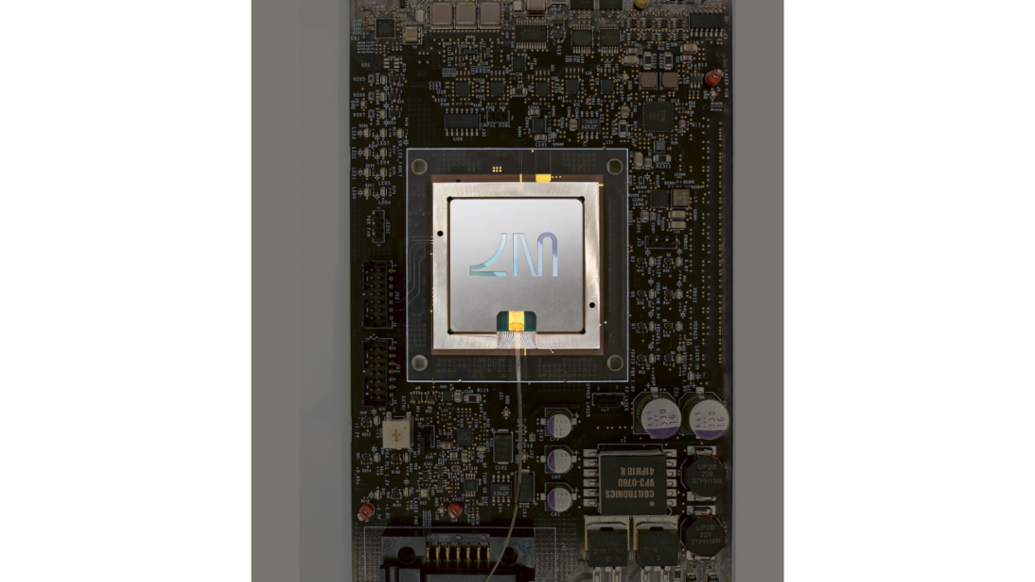
Computing with light: Lightmatter’s Envise chip uses photons instead of electrons to calculate neural networks. The input and output data is supplied and received by conventional electronics.
With the combination of optical and digital computing, DNNs can be computed extremely quickly. “Their main advantage is low latency,” explains Lindsey Hunt, a spokesperson for Lightelligence. For example, this allows the DNN to detect objects in images faster, such as pedestrians and e-scooter riders. In autonomous driving, this could lead to faster reactions in critical situations. “In addition, the optical system makes more decisions per watt of electrical energy,” Hunt said. That’s especially important as increasing computing power in vehicles increasingly comes at the expense of fuel economy and range.
The solutions from Lightmatter and Lightelligence can be inserted as modules into conventional computers to speed up AI computations—much like graphics cards. In principle, they could also be integrated into vehicles, for example to implement autonomous driving functions. “Our technology is very well suited to serve as an inference engine for an autonomous car,” explains Lindsey Hunt. AI expert Schaper has a similar view: “If Lightelligence succeeds in building components suitable for automobiles, this could greatly accelerate the introduction of complex AI functions in vehicles.” The technology is now ready for the market: The company is planning its first pilot tests with customers in the year 2022.
The quantum computer as an AI turbo
Quantum computers are somewhat further away from practical application. They, too, will accelerate AI calculations because they can process vast amounts of data in parallel. To do this, they work with so-called “qubits.” Unlike the classical unit of information, the bit, a qubit can represent the two binary values 0 and 1 simultaneously. The two numbers coexist in a superposition state that is only possible in quantum mechanics.
“The more complicated the patterns, the more difficulty conventional computers have distinguishing classes.”Heike Riel, Lead IBM Research Quantum Europe/Africa
Quantum computers could turbocharge artificial intelligence when if comes to classifying things, for example in traffic. There are many different categories of objects there, including bicycles, cars, pedestrians, signs, wet and dry roads. They differ in terms of many properties, which is why experts talk about “pattern recognition in higher-dimensional spaces.”
“The more complicated the patterns, the harder it is for conventional computers to distinguish classes,” explains Heike Riel, who heads IBM’s quantum research in Europe and Africa. That’s because with each dimension, it becomes more costly to calculate the similarity of two objects: How similar are an e-scooter rider and a rollator user trying to cross the street? Quantum computers can work efficiently in high-dimensional spaces compared to conventional computers. For certain problems, this property could be useful and result in some problems being solved faster with the help of quantum computers than with conventional high-performance computers.
Heike Riel, Lead IBM Research Quantum Europe/Africa
IBM researchers have analyzed statistical models that can be trained for data classification. Initial results suggest that cleverly chosen quantum models work better than conventional methods for certain datasets. The quantum models are easier to train and appear to have greater capacity—allowing them to learn more complicated relationships.
Riel admits that while today’s quantum computers can be used to test these algorithms, they do not yet have an advantage over conventional computers. However, the development of quantum computers is progressing rapidly. Both the number of qubits and their quality are steadily increasing. Another important factor is speed, measured in Circuit Layer Operations per Second (CLOPS). This number denotes how many quantum circuits can run on the quantum computer per time. It is one of the three important performance criteria of a quantum computer: scalability, quality, and speed.
In the foreseeable future, it should be possible to demonstrate the superiority of quantum computers for certain applications—that is, that they solve problems faster, more efficiently, and more precisely than a conventional computer. But building a powerful, error-corrected, general-purpose quantum computer will still take some time. Experts estimate that it will take at least another ten years. But the wait could be worth it. Like optical chips or new architectures for electronic computers, quantum computers could be the key to the mobility of the future.
In brief
When it comes to AI calculations, not only conventional microprocessors, but also graphics chips, are now reaching their limits. Companies and researchers worldwide are therefore working on new solutions. Chips in wafer format and light computers are close to becoming reality. In a few years, these could be supplemented by quantum computers for particularly demanding calculations.
Drive2Extremes: the Taycan Turbo Cross Turismo between ice and desert
In the clip “Drive2Extremes. Taycan Cross Turismo x Johnny FPV”, the CUV demonstrates its typically Porsche sportiness on unpaved roads in the desert and on ice. The precision of the drone pilot Johnny FPV transports the viewer from one world to the other in seamless motion.
A hot-air balloon glides over seemingly endless forests of pine. A sports car is drifting in the snow. Between the two, a drone slices through the air, before it swoops down dramatically and captures the car at breakneck speed. A winter landscape? The eye can scarcely apprehend how the flight manuever suddenly transitions to a desert. The music underscores the dynamic acts of cinematography and driving like a symphony of contrasts. The locations provide the extremes in this action film: snow in Finland, desert sands in the United Arab Emirates. The protagonist is the Porsche Taycan Turbo Cross Turismo.
“It’s important to fly in a unique way, to establish a trademark style.”Johnny FPV
The second hero is somewhat in the background. Johnny FPV has both feet on the frozen ground, about 60 miles north of the Arctic Circle, as he works his magic from the bird’s-eye view above. One of the best drone pilots in the world, he is wearing black video glasses and holding a controller. Gloves protect his hands from the icy air – the filmmaker’s biggest challenge today, as he films against the stunning backdrop of the Porsche Driving Area – a closed course with prepared ice tracks.
The long view: with the camera eye of his drone, Johnny FPV tracks the Porsche Taycan Turbo Cross Turismo on two identical course layouts on two continents.
Born Johnny Schaer, the three initials in his professional handle stand for “first-person view” – the camera perspective of the films that have turned his passion into a career. Thanks to instantaneous transmission speeds, the drone pilot sees the world through the eye of his camera. Later, the viewer experiences the spectacular flights with sensory directness. The 25-year-old from Chicago loves speed, cars and flying, and is known for exceptionally dexterous maneuvers. Few can match his skill in making the viewer a part of the action. He opens up new horizons, offering surprising dimensions in technical perfection. Watching him and his drone at work, one senses how the virtual and real worlds meld into one.
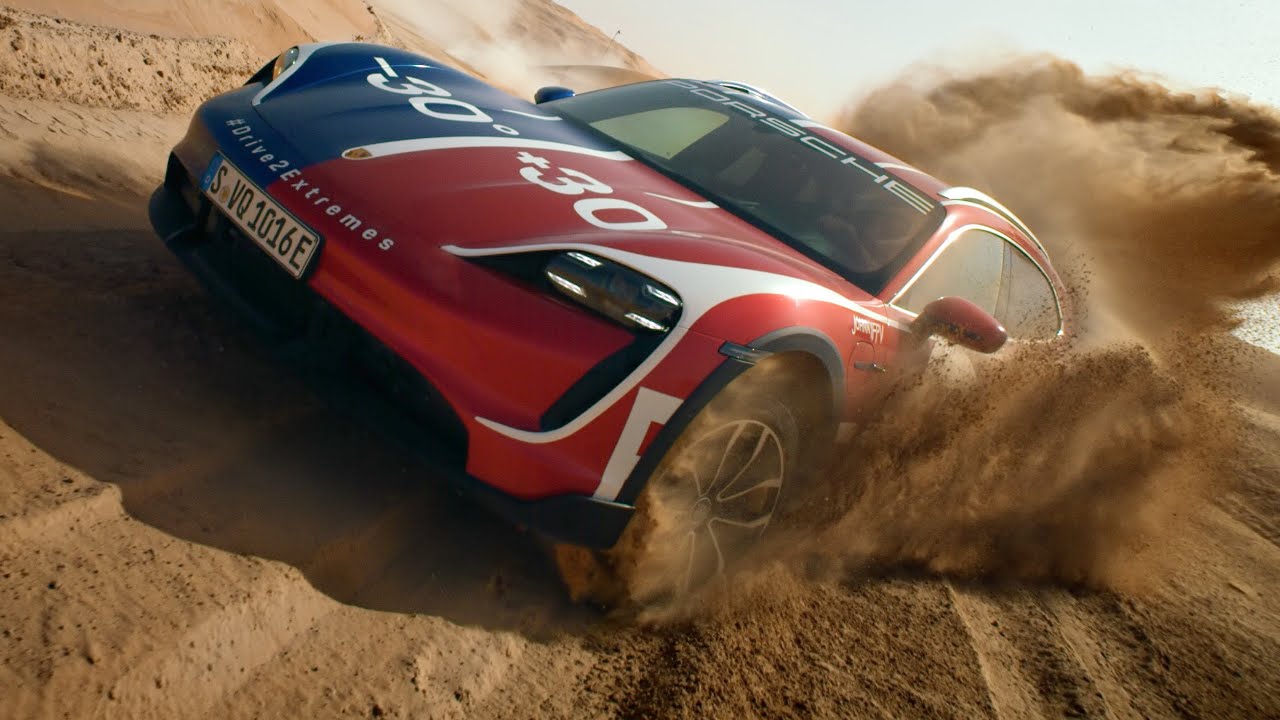
Two-tone: the striking red and blue foiling symbolises heat and cold. The script adds further extremes.
Dancing on ice: there is a spirit of adventure in every detail of the Taycan Turbo Cross Turismo. The snow mutes almost every sound coming from the tyres. A silent drift is all but unimaginable, yet possible.
Dancing on ice: there is a spirit of adventure in every detail of the Taycan Turbo Cross Turismo. The snow mutes almost every sound coming from the tyres. A silent drift is all but unimaginable, yet possible.
The film – Drive2Extremes. Taycan Cross Turismo x Johnny FPV – is set in the Lapland town of Levi and the Liwa Oasis on the northern edge of the Rub al Khali desert. More than 3,100 miles as the crow flies and roughly 1400 degrees Fahrenheit separate the two filming locations but in both places the Taycan Turbo Cross Turismo, the first all-electric Cross Utility Vehicle (CUV) from Porsche, conquers identically set courses. The aerial precision of the drone pilot is what allows the gripping splicing of the shots between ice and desert. The film was directed by Los Angeles-based Nicholas Schrunk, who won an Emmy for the documentary Blood Road. He’s a master of the craft of accentuating emotional stories with spectacular stunts.
Teamwork: director Nicholas Schrunk, racing car driver Jukka Honkavuori, and drone pilot Johnny FPV (from left) collaborated on the video spot.
Schaer bought his first drone at the age of 15, followed days later by a second, and shortly thereafter by a third. He practiced relentlessly. He got good. And then he became a pro. “Hand-eye coordination is crucial to being a good pilot. Otherwise it’s just a mix of hard work, good ideas and talent,” he says. In Drive2Extremes, the shots are dynamic in multiple ways. The car moves forward – the drone in all directions. Schaer has developed his own style and it is one that captivates the viewer. “It’s important to fly in a unique way, to establish a trademark style. My videos bear my signature. They’re not jerky, they’re precise and they’re very fluid.”
In just seven years, he’s ascended into the upper echelons of FPV pilots. “It’s indescribable to see and feel how strongly the Taycan Turbo Cross Turismo performs on different surfaces. I knew that electric cars accelerate very quickly, but the fact that the power can be called up like that on ice and sand is something I find incredible.” For him, electric cars are the future. “I’m quite sure I’ll own one too,” says Schaer. With his film, one ‘wow’ moment follows another, punctuated by breathtakingly beautiful slow-motion sequences. The Cross Turismo and its filmmaker – two masters in two different worlds.
https://www.myluxepoint.com/wp-content/uploads/2021/09/Drive2Extremes-the-Taycan-Turbo-Cross-Turismo-between-ice-and-desert.jpg7201280Carloshttps://www.myluxepoint.com/wp-content/uploads/2017/11/logo2v-1.pngCarlos2021-09-06 11:55:182021-09-06 11:55:18Drive2Extremes: the Taycan Turbo Cross Turismo between ice and desert
“Porsche Unseen” provides a glimpse of unreleased concept cars
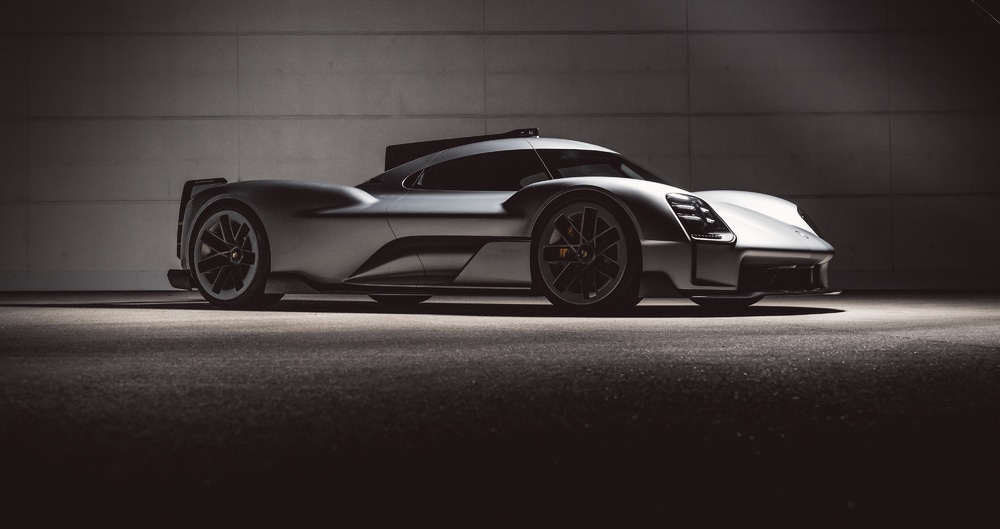
Stuttgart, Germany. Under the title “Porsche Unseen”, Porsche is for the first time publishing design studies from 2005 to 2019 which have until now been kept under lock and key. The sports car manufacturer is showing spectacular visions of 15 different cars. The early studies cover the segments “Spin-offs“, “Little rebels“, “Hyper cars“ and “What’s next?”. In this way, Porsche is offering an exclusive insight into its design process – from the very first drawing to the finished model ready for series production.
“Porsche Unseen” provides a glimpse of unreleased concept cars
“People all over the world love the timeless and innovative design of our sports cars,” says Oliver Blume, Chairman of the Executive Board at Porsche AG. “Visionary concept studies are the foundation of this success: they provide the pool of ideas for the Porsche design of tomorrow, and combine our strong tradition with trailblazing future technologies.”
“Porsche Unseen” provides a glimpse of unreleased concept cars
The previously unpublished design studies are being presented exclusively by the Porsche Newsroom in a series of articles. The 911:Magazine web TV format has also dedicated an episode to selected studies and examines the connection between the studies and the current production models together with Porsche Chief Designer Michael Mauer. For fans of the brand, the book entitled “Porsche Unseen” is released today by the Delius Klasing publishing house. Interested readers are given a detailed look behind the scenes of Style Porsche. A selection of studies will also be on display later for fans to admire live: the Porsche Museum will be integrating the models in the exhibition in 2021.
The design process: from the first drawing to the drivable prototype
The design process starts with a sketch. This is visualised in the next step as a 3D model. As soon as an idea is to be developed further, small models are produced in a scale of 1:3, then followed by hard models in the scale 1:1. “The virtual world is the first step, but you especially have to experience the unusual models in reality in order to understand whether a car has small, large or surprising proportions,” says Michael Mauer, Vice President Style Porsche. In contrast to the development of a production model where several models are always developed with different styling formats, the vision projects, on the other hand, concentrate on a single vision model which serves as a protagonist for the central idea.
“Porsche intentionally has just a single design studio – located in the direct proximity of development,” says Michael Mauer. “Weissach is our epicentre. Instead of opening advanced design studios in the distant metropolises of North America and Asia, our designers come from all over the world to Porsche in Weissach in order to create the latest production sports cars and automotive visions at the heart of the brand. More than 120 designers, experts for interior, exterior, colours and materials, model builders, modellers and study engineers work in the Porsche Design Studio.
“Porsche Unseen” provides a glimpse of unreleased concept cars
The design studies: on a journey of the mind into the future of mobility
“When it comes to the visions we develop, it is not about bringing every car onto the road. Instead, it is more a question of establishing creative space and a relationship with the future,” says Michael Mauer when describing the design process and adds: “There are two possibilities for continuing to develop as a brand: either you improve your products from the present, that is to say step-by-step. However, it is difficult to be really innovative in this process. Or you give free rein to your creativity. The idea is to let your thoughts jump to the day after tomorrow, and to then move back from there to tomorrow.”
Based on this idea, Porsche develops the product and brand identity which characterises and secures the appearance of all models in the long term. The design language for future models develops from the long-term vision. In this process, the higher-level goal is to combine the Porsche design DNA with state-of-the-art vehicle engineering. On the one hand, this secures the innovative capability of future Porsche models and, on the other, also provides an evolutionary reference to the rich history of Porsche. A closer look at some examples:
The Porsche 919 Street (2017; 1:1 clay model) was developed on the basis of the technology used in the Porsche 919 Hybrid, promising to make the exhilarating driving experience of the LMP1 race car available to amateur drivers. Under the outer shell are the carbon monocoque and powerful 900 PS hybrid racing drivetrain that helped the Porsche 919 to achieve numerous victories at Le Mans. The dimensions and wheelbase were also the same as on the race car.
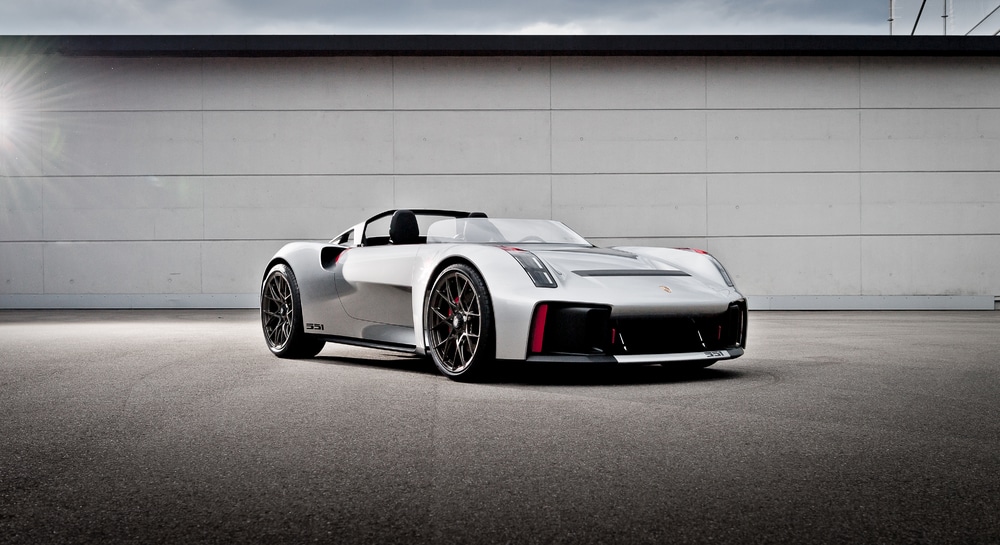
With its spartan, puristic cockpit, the characteristic radiator grilles over the mid engine, red graphic elements and the suggested fins at the rear, the compact Porsche Vision Spyder (2019; 1:1 hard model) clearly calls to mind the Porsche 550-1500 RS Spyder from 1954. At the same time, the study was intended to further develop the design identity of Porsche and provide a pool of ideas for future details – for example, the ultra-modern roll bar.
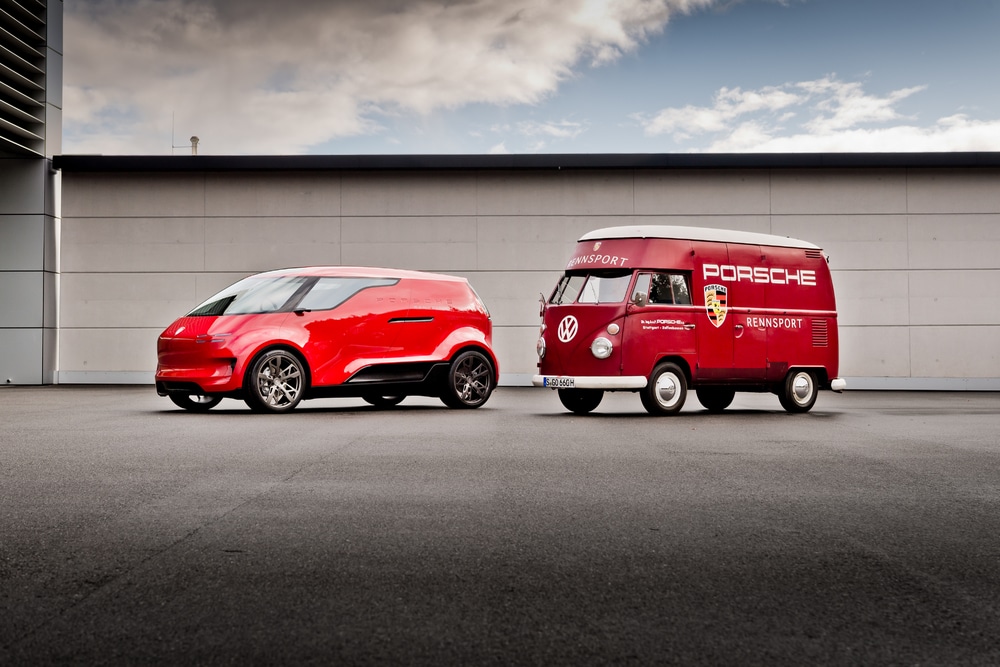
The Porsche vision “Renndienst” (2018; 1:1 hard model) is the free interpretation of a family-friendly space concept for up to six persons. The design team designed a futuristic “space shuttle“ with exciting proportions. The study shows how the Porsche design DNA with its characteristic surface modelling can be transferred to an unknown vehicle segment for the brand. In the interior, passengers find a comfortable and modular travel cabin. The driver sits in a central driver’s seat. The all-electric drive technology is located in the underbody. As a result, passengers can enjoy an unexpectedly generous space and travel experience combined with Porsche-like flair.
The book “Porsche Unseen” is now available from retailers with the ISBN number 978-3-667-11980-3. The design studies are presented in detail over 328 pages with impressive photos from Stefan Bogner and informative text by Jan Karl Baedeker. It is published by Delius Klasing Verlag and is also available in the Porsche Museum shop.